Buying Guide
Concrete Floor Scrubber: How to Clean Sealed and Unsealed Concrete
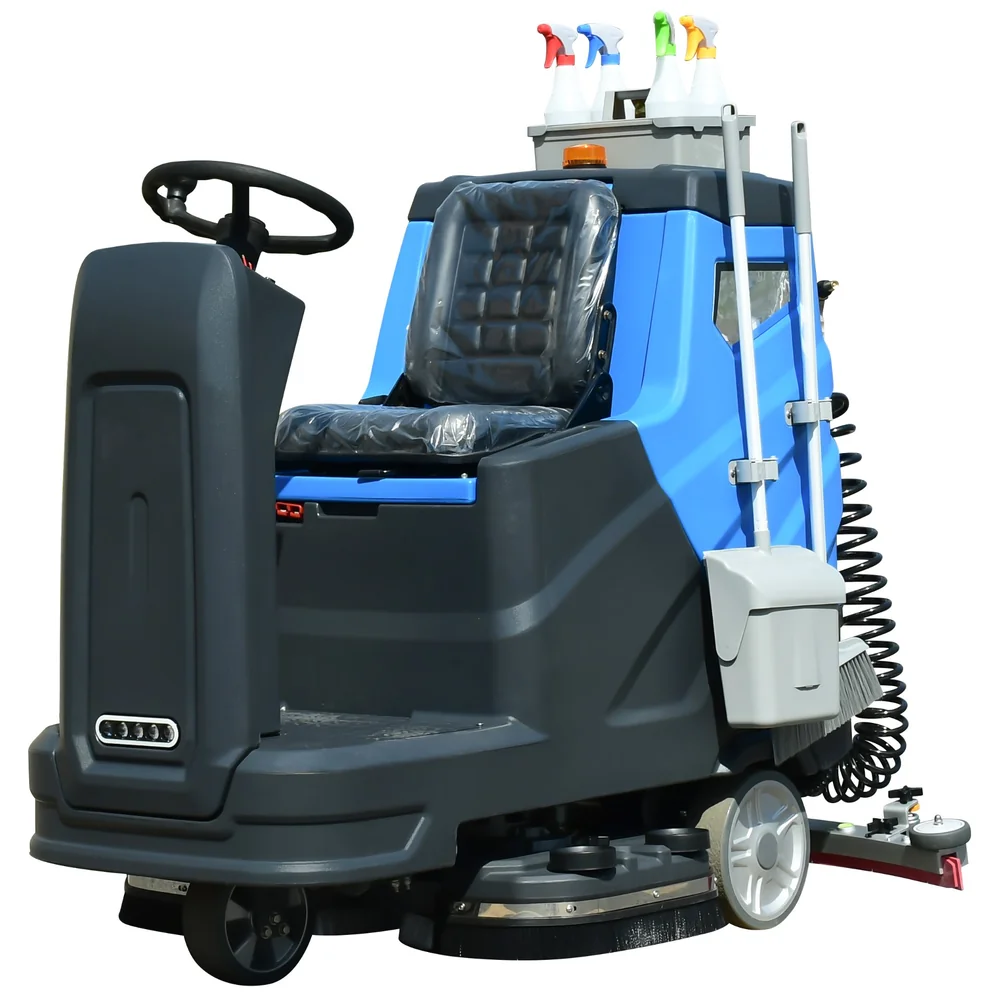
Quick answer: A concrete floor scrubber cleans concrete with a rotating brush or pad, a detergent solution and a vacuum squeegee that dries the floor in one pass. Sealed concrete behaves like any smooth hard floor; unsealed concrete is porous, so it needs lower water flow, a stiffer brush and more recovery tank capacity. Machine choice is driven by floor area, not by model name.
Key takeaways
- Porosity decides everything. Unsealed concrete drinks water and detergent, so the recovery tank fills more slowly and the floor dries slower.
- Brush matters more than motor power. Stiff polypropylene for rough concrete, soft nylon or a pad for sealed and polished floors.
- Streaks are a squeegee problem, not a water problem in nine cases out of ten.
- Sweep before you scrub. Dry grit under a spinning brush acts like sandpaper on concrete.
- Size by area: 520 mm walk-behind for small sites, 760-860 mm ride-on above roughly 10,000 m².
Why concrete is harder to clean than epoxy
Concrete is not a coating; it is a porous substrate. Three properties make it a different cleaning job from epoxy or tile:
- It absorbs. Unsealed concrete pulls water and detergent into the surface, so less dirty solution comes back into the recovery tank and drying takes longer.
- It generates fine dust. Concrete dust mixes with water into a sludge that settles fast — which is why recovery tank capacity and daily emptying matter.
- Its surface profile varies. A power-trowelled warehouse slab, a broom-finished loading bay and a polished retail floor need three different consumables on the same machine.
Sealed versus unsealed concrete: what changes
| Sealed / polished concrete | Unsealed / porous concrete | |
|---|---|---|
| Water behaviour | Stays on the surface, high recovery | Soaks in, lower recovery |
| Consumable | Soft nylon brush, or pad | Stiff polypropylene brush |
| Detergent | pH-neutral, low foam | pH-neutral to mildly alkaline; no strong acid |
| Drying | Fast, near-immediate | Longer; plan a second dry pass |
| Tank priority | Clean-water capacity | Recovery capacity |
Brush or pad: picking the consumable
| Option | Use it when | Note |
|---|---|---|
| Stiff polypropylene brush | Rough, unsealed, outdoor or loading-bay concrete | Most aggressive scrubbing; leaves a slightly textured surface |
| Soft nylon brush | Sealed or smooth indoor concrete | Gentler and quieter, longer life on smooth floors |
| Pad holder + pad | Polished or coated concrete needing a uniform finish | Cheapest consumable; best for daily light-duty cleaning |
Water, detergent and dwell time
The practical rule: the solution flow should leave a thin film that the squeegee fully recovers within one to two metres behind the machine. If you can see streaks drying behind you, either the flow is too high or the squeegee blade is worn.
- Dose to the label, not by eye. Foam is what kills vacuum motors, and over-dosing detergent is the usual cause.
- Use dwell time on the first clean. On heavily soiled concrete, scrub without vacuum on pass one, then vacuum on pass two.
- Empty the recovery tank daily. Concrete sludge hardens, and a hardened tank is a half-day job to clear.
Sizing the machine to your floor area
| Daily floor area | Class | Model | Cleaning path | Rated capacity |
|---|---|---|---|---|
| Up to 3,000 m² | Small walk-behind | AS560 | 520 mm | 2,600 m²/h |
| 3,000-6,000 m² | Compact ride-on | AS700 (Single Brush) | 560 mm | 3,000 m²/h |
| 6,000-10,000 m² | Ride-on, double brush | AS700 (Double Brush) | 660 mm | 3,600 m²/h |
| 10,000-20,000 m² | Industrial ride-on | AS800 (Double Brush) | 760 mm | 4,600 m²/h |
| 20,000 m² and up | Flagship ride-on | AS900 (Double Brush) | 860 mm | 5,600 m²/h |
All five carry lead-acid battery packs as standard and are quoted FOB Qingdao with a 12-month warranty. Related reading: walk-behind versus ride-on floor scrubbers and our warehouse floor cleaning guide.
Five mistakes that damage concrete floors
- Too much water on unsealed concrete. It soaks in, lifts the surface and slows drying.
- Wrong consumable. A soft brush on rough concrete cleans nothing; a stiff brush on polished concrete scuffs it.
- Leaving sludge in the recovery tank overnight. It hardens into a cement-like layer.
- Running on a worn squeegee blade. Streaks are almost always the blade, not the flow setting.
- Scrubbing without removing grit first. Dry grit under a rotating brush grinds the surface.
Frequently asked questions
Can you use a floor scrubber on unsealed concrete?
Which brush should I use on rough concrete?
How much water does a concrete floor scrubber use?
Does a floor scrubber remove oil stains from concrete?
Is a ride-on scrubber safe on polished concrete?
What detergent pH is right for concrete?
Need a model recommendation?
Tell us the job — FOB Qingdao quotation within 24 hours. MOQ 1 unit.