Buying Guide
Walk-Behind vs Ride-On Floor Scrubber: How to Choose
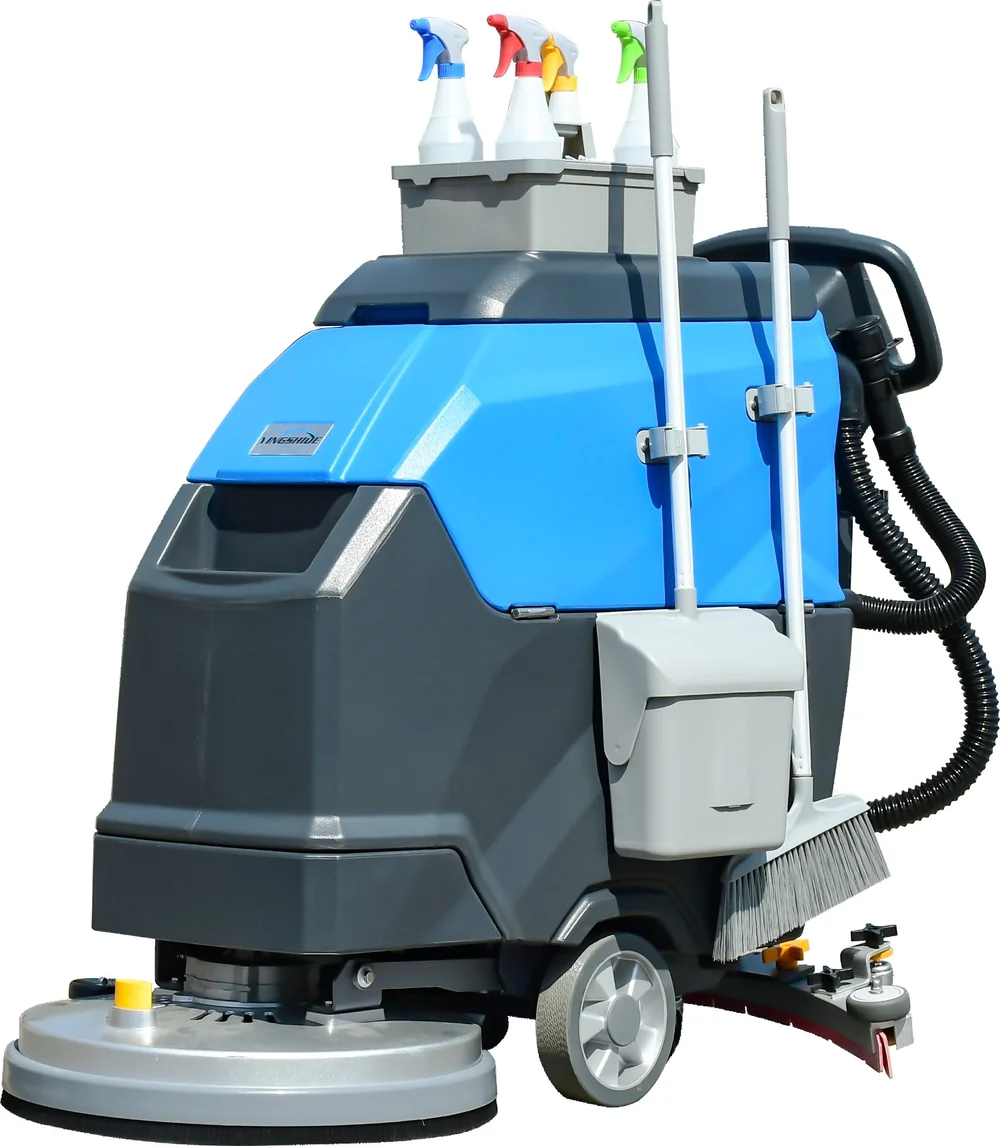
It is the first question every buyer asks when shopping for an industrial floor scrubber: should I buy a walk-behind floor scrubber or a ride-on one? Choose wrong and you either pay for capacity you never use, or push a machine eight hours a day and still fall behind. Here is the decision framework we use with purchasing teams — with real numbers from our own 520–860 mm range.
What a walk-behind floor scrubber does best
A walk-behind floor scrubber is the operator pushes (or a self-propelled motor drives) while brushes scrub and a squeegee vacuum dries behind. Strengths:
- Access. Our walk-behind AS560 is 1,400 mm long, 830 mm wide and 150 kg — it passes standard single doors, passenger lifts and narrow storeroom aisles where no ride-on fits.
- Price. Indicative FOB Qingdao for the whole AS range is USD 1,200–2,800, and walk-behind machines sit at the lower end.
- Simplicity. No seat, no driving — any cleaner can operate it after a ten-minute briefing.
The trade-off is pace: the operator walks at about 3–4 km/h, so practical output is roughly 2,000–2,600 m²/h — the AS560 is rated at 2,600 m²/h with its 520 mm brush.
What a ride-on floor scrubber does best
On a ride-on floor scrubber (US buyers also say riding floor scrubber; European sites often say ride-on scrubber dryer — same machine) the operator sits and drives, so fatigue stops being the limit. Strengths:
- Capacity. Wider decks and steady speed: the AS700 (560 mm, 3,000 m²/h), AS700 double-brush (660 mm, 3,600 m²/h), AS800 (760 mm, 4,600 m²/h) and AS900 (860 mm, 5,600 m²/h) scale from compact to industrial duty.
- Tank size. Bigger machines carry bigger tanks — the AS900’s 165 L clean / 170 L recovery tanks mean far fewer refill stops than the AS560’s 55 L/60 L.
- Runtime. 3–4 h (AS800) and 4–5 h (AS900) working times cover a full shift without recharging.
Side-by-side comparison
| Walk-behind (AS560) | Ride-on (AS700–AS900) | |
|---|---|---|
| Cleaning path | 520 mm | 560–860 mm |
| Rated capacity | 2,600 m²/h | 3,000–5,600 m²/h |
| Water tanks | 55 L / 60 L | 90–165 L / 80–170 L |
| Working time | 2–3 h | 2–3 h to 4–5 h |
| Operator fatigue | Walks the whole shift | Seated, minimal |
| Access | Doors, lifts, narrow aisles | Needs ramps and turning room |
| Indicative FOB Qingdao | USD 1,200–2,800 across the range | |
The 2.5-hour rule
Size the machine to your floor area, not to your budget alone. At walk-behind pace, a daily full pass on anything above roughly 6,000 m² takes more than 2.5 hours — and past that point a compact ride-on usually pays back within the first year in recovered labor. Quick guide:
- Under 2,000 m²: a small floor scrubber like the AS560 is the right tool.
- 3,000–10,000 m²: compact ride-on — AS700 or AS800.
- Above 10,000 m²: full-size industrial floor scrubber — the AS900.
Terminology: scrubber, scrubber dryer, riding floor scrubber
One note that saves confusion when comparing suppliers: US sites say floor scrubber or riding floor scrubber, while European sites say scrubber dryer (because the machine dries the floor in the same pass). They describe the same equipment. When you compare quotes, check cleaning width, tank volumes and rated m²/h — not the label.
Send your floor plan, get one recommendation
Tell us your daily area, floor type and the narrowest aisle — we will recommend exactly one model (walk-behind or ride-on) and quote FOB Qingdao within 24 hours. MOQ is 1 unit. Browse the full walk-behind and ride-on scrubber range with complete specifications.
Frequently asked questions
Walk-behind or ride-on floor scrubber: which should I buy?
Is a scrubber dryer the same thing as a floor scrubber?
Will a ride-on scrubber fit through my doors and lifts?
How long does a full pass take?
How much does a floor scrubber cost?
Can I buy just one machine to start?
Need a model recommendation?
Tell us the job — FOB Qingdao quotation within 24 hours. MOQ 1 unit.