Buying Guide
Commercial Floor Scrubber Buying Guide: Sizing, Battery and Running Costs
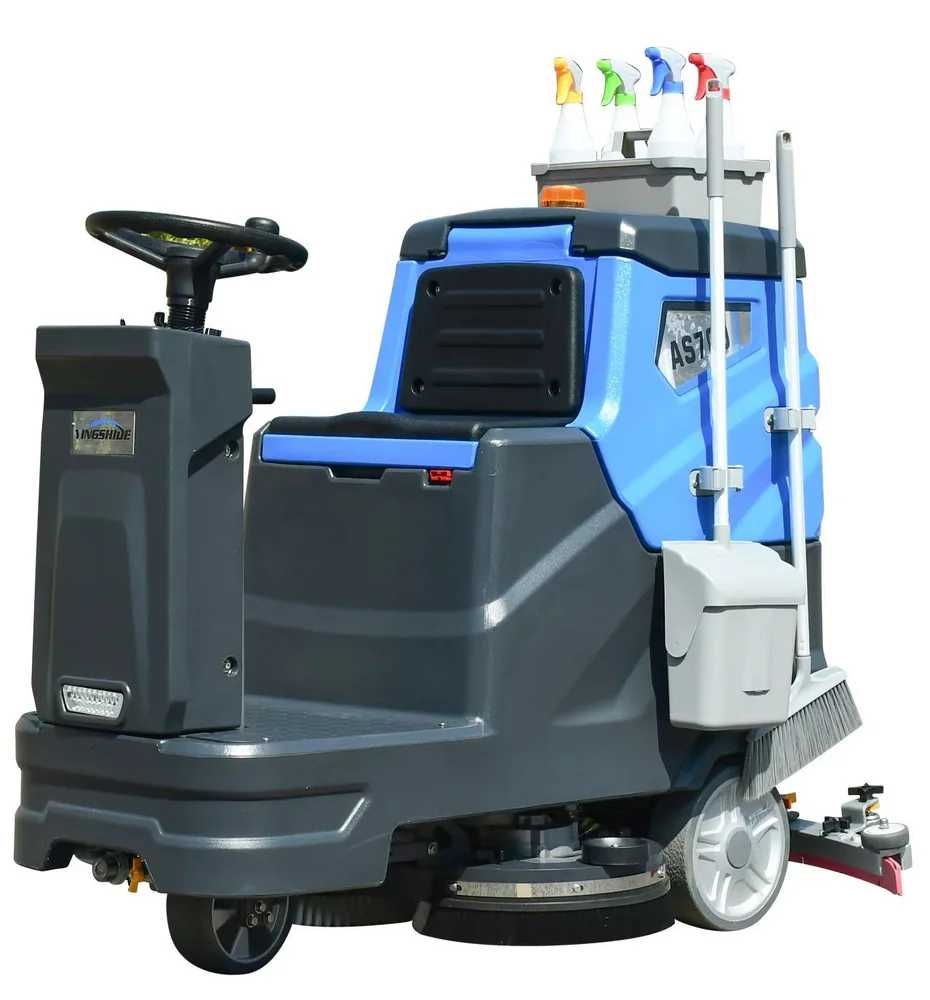
Quick answer: A commercial floor scrubber is a battery-powered machine that scrubs and dries hard floors in one pass. Choose it in four steps: size it to your daily floor area, match battery runtime to your shift length, pick the brush or pad for your surface, then check the running costs. Most buyers who get this wrong buy too small and end up running two shifts on a machine rated for one.
Key takeaways
- Size by area first. Floor area per shift, not headcount or budget, decides the machine class.
- Match runtime to the shift. Battery-electric machines run 2-5 hours per charge; a two-shift site needs a larger pack or a midday charge.
- Labour, not the machine, is the cost. A ride-on replaces roughly 8-11 mop-hours per machine-hour.
- Surfaces change the consumable, not the machine. One machine with two brush types covers epoxy, tile and concrete.
- Ask for QC evidence before the deposit — photos and video of your actual machines, and in writing which market documents the supplier can provide.
What counts as a commercial floor scrubber
Terminology first, because suppliers and buyers use different words for the same machine. In the US a commercial floor scrubber usually means a battery-electric automatic scrubber used in shops, offices, hospitals and warehouses. UK and European sites often call the same machine a scrubber dryer, and a large operator-driven machine a riding floor scrubber. All three describe a machine with a brush or pad, a solution tank, a recovery tank and a vacuum squeegee.
Step 1: size the machine to your floor area
| Daily area | Class | Model | Cleaning path | Capacity | Runtime |
|---|---|---|---|---|---|
| Up to 3,000 m² | Walk-behind | AS560 | 520 mm | 2,600 m²/h | 2-3 h |
| 3,000-6,000 m² | Compact ride-on | AS700 (Single Brush) | 560 mm | 3,000 m²/h | 2-3 h |
| 6,000-10,000 m² | Ride-on, double brush | AS700 (Double Brush) | 660 mm | 3,600 m²/h | 2-3 h |
| 10,000-20,000 m² | Industrial ride-on | AS800 (Double Brush) | 760 mm | 4,600 m²/h | 3-4 h |
| 20,000 m² and up | Flagship ride-on | AS900 (Double Brush) | 860 mm | 5,600 m²/h | 4-5 h |
A useful sanity check: divide your floor area by the rated capacity, then add 20-30% for turning, refilling and edges. If the number lands close to your shift length, go one size up.
Step 2: battery and runtime
Every model in our range ships with maintenance-free lead-acid battery packs — 24V100AH on the AS560 and AS700, 24V150AH on the AS800 and 24V200AH on the AS900. Practical consequences:
- One shift, one charge. 2-3 h covers a typical night-clean on small sites; 4-5 h covers a full warehouse shift.
- Two-shift sites need either a midday top-up charge or the larger pack on the AS900.
- Lithium packs can be quoted on request where a customer wants faster charging or opportunity charging, but lead-acid remains the default because it is cheaper to replace and serviceable anywhere.
Step 3: match the consumable to the surface
| Surface | Consumable | Why |
|---|---|---|
| Epoxy or coated | Soft brush or pad | Avoids scuffing the coating |
| Polished concrete or terrazzo | Pad holder + pad | Uniform finish, lowest consumable cost |
| Rough or unsealed concrete | Stiff polypropylene brush | Reaches into the surface profile |
| Tile with grout lines | Soft brush | Cleans grout without damage |
Step 4: water and detergent consumption
Tank sizes run from 55 L (AS560) to 165 L clean / 170 L recovery (AS900). The number that matters operationally is refill stops per shift: small machines stop roughly every 1.5-2 hours, the AS900 typically once per shift. Detergent is dosed to the label — over-dosing creates foam, which is the fastest way to destroy a vacuum motor.
What the running costs actually are
Three buckets, and only one of them is large:
- Energy: small. A 24V100AH pack stores about 2.4 kWh (24 V x 100 Ah). At an assumed USD 0.15 per kWh, a full charge is roughly USD 0.36 — assumption only, check your local tariff.
- Labour: the real number. Manual mopping runs at roughly 400-600 m² per person-hour. A 4,600 m²/h ride-on therefore replaces about 8-11 person-hours per machine-hour. This is the line that justifies the purchase.
- Consumables: predictable. Brushes and squeegee blades wear faster on rough concrete than on smooth epoxy; budget them as a per-quarter item, not a per-year item.
Seven questions to ask a supplier before you pay
- Will I get photos and video of my machines on the line before loading?
- Which market-specific documents can you provide — confirmed in writing before the deposit?
- What exactly does the warranty cover, and are spare parts stocked?
- What is the lead time after deposit, in writing?
- Which payment methods do you accept, and can I use platform protection?
- Can I mix models in one container?
- Who answers the phone at month eleven?
Our own answers are consistent across the range: FOB Qingdao, MOQ 1 unit, indicative USD 1,200-2,800 depending on model, 15-25 days after deposit, T/T or Alibaba.com Pay, 12-month warranty with spare parts and video guidance. Detailed specs are on each model page, and our import guide from China covers documents and container loading step by step.
Frequently asked questions
What size floor scrubber do I need for 5,000 m2?
Electric or propane floor scrubber?
How long does the battery last per charge?
Can one machine clean both epoxy and concrete?
What is the MOQ and lead time?
What does the warranty cover?
Need a model recommendation?
Tell us the job — FOB Qingdao quotation within 24 hours. MOQ 1 unit.